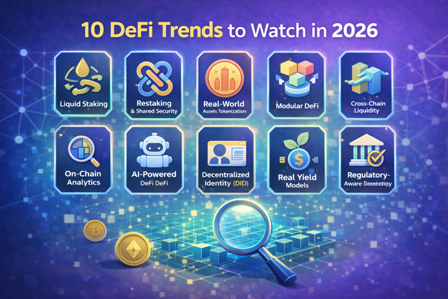
Decentralized Finance (DeFi) continues to evolve rapidly. As blockchain adoption grows, new innovations are reshaping how people earn, trade, and manage digital assets. Here are the most important DeFi trends to watch in 2026.
Table of Contents
- Liquid Staking Dominance
- Restaking and Shared Security
- Real-World Assets Tokenization
- Modular DeFi Infrastructure
- Cross-Chain Liquidity Expansion
- On-Chain Analytics and Transparency
- AI-Powered DeFi Tools
- Decentralized Identity (DID)
- Sustainable and Real Yield Models
- Regulatory-Aware DeFi Design
1. Liquid Staking Dominance
Liquid staking allows users to stake crypto assets while still using them in DeFi applications. This improves capital efficiency and increases overall network participation.
2. Restaking and Shared Security
Restaking enables staked assets to secure multiple protocols at once, creating new yield opportunities and enhancing blockchain security.
3. Real-World Assets (RWA) Tokenization
Real-world assets such as bonds, real estate, and commodities are increasingly being tokenized and brought on-chain, attracting institutional interest.
4. Modular DeFi Infrastructure
DeFi protocols are shifting toward modular architectures, allowing faster innovation, easier upgrades, and better scalability.
5. Cross-Chain Liquidity Expansion
Cross-chain technology enables assets to move seamlessly between blockchains, reducing liquidity fragmentation and improving user experience.
6. On-Chain Analytics and Transparency
On-chain analytics tools are becoming essential for tracking protocol health, smart money movements, and overall market trends.
7. AI-Powered DeFi Tools
Artificial intelligence is increasingly used in DeFi for risk analysis, automation, and trading optimization.
8. Decentralized Identity (DID)
Decentralized identity solutions improve privacy, governance participation, and regulatory compliance without central control.
9. Sustainable and Real Yield Models
DeFi is moving away from unsustainable high APYs toward real yield generated from protocol fees and genuine economic activity.
10. Regulatory-Aware DeFi Design
Protocols are adopting optional compliance layers to support global adoption while maintaining decentralization.
Final Thoughts
DeFi in 2026 is evolving into a more mature and sustainable financial ecosystem. Understanding these trends can help users and investors stay ahead in the rapidly changing DeFi landscape.